CHAPTER ONE A Second Chance
Amid grief and uncertainty, an unexpected second chance became the beginning of a lifelong search for purpose.
I stood frozen in the St. Louis airport, staring at a television screen above a sports bar.
The volume was turned up too loud. Around me, travelers had stopped mid-stride, bags at their feet, eyes fixed on the same images repeating in an endless loop. Smoke billowing from the Twin Towers. Bodies falling. The second plane hitting. The Pentagon in flames.
And then the anchor's voice, clinical and steady despite what he was reporting:
"United Flight 93, which departed Newark this morning, has crashed in a field near Shanksville, Pennsylvania. There are no survivors."
United Flight 93.
Newark.
My flight. The one I'd changed the night before on a whim.
My legs went numb. The terminal noise… announcements, crying, shouted phone calls, all faded into white static. Time collapsed. I couldn't move. Couldn't breathe.
I should be dead.
That plane, that exact flight, from that exact airport—was supposed to take me to San Francisco this morning for a board meeting. Instead, I'd rebooked to American Airlines out of JFK. Closer to home. Better for mileage points.
A whim.
That's all it was. A quiet thought the night before: Switch airlines. Fly out of JFK instead.
And now everyone on my original flight was gone.
I don't know how long I stood there. Seconds? Minutes? The images kept repeating. The towers collapsing. The field in Pennsylvania, burning.
I was supposed to be on that plane.
My hands started shaking. My throat closed. The world around me blurred as my mind struggled to process what this meant. Some force, call it instinct, call it luck, call it something I didn't yet have a name for—had intervened. Had whispered. Had saved my life.
I finally moved. One foot, then the other. I had to get out of this airport.
September 11, 2001
Let me go back.
The day before, September 10, I was home in Connecticut, packing for a business trip to San Francisco. I was fifty-nine years old, an angel investor in several dot-com ventures, living a life of endless flights, board meetings, and deals.
I'd booked United Flight 93 out of Newark just days earlier. But that evening, as I reviewed my itinerary, something shifted. A quiet nudge. Barely a thought.
Fly out of JFK instead. It's closer. You earn miles with American.
I changed the ticket. No drama. No divine intervention that I could name. Just a small decision that felt logical. The next morning, September 11, I boarded American Airlines at JFK at 8:00 a.m.
United Flight 93 took off from Newark at 8:42 a.m., delayed by routine traffic. One hour and forty-five minutes into my flight, the captain's voice came over the intercom, clipped and tense: "Severe turbulence ahead. Crew, secure the cabin immediately."
I barely had time to fasten my seatbelt before the plane dropped. A sudden, violent descent that sent my stomach into my throat. Passengers gasped. A woman across the aisle gripped her armrests, knuckles white. Through my window, I saw the stainless steel Gateway Arch rising up—silver, unmistakable, too close.
St. Louis.
We were landing in St. Louis, Missouri.
Grounded
At 9:45 a.m., U.S. airspace was shut down. Every civilian aircraft in the sky was ordered to land immediately. Our plane touched down. The flight attendant's voice, shaky but controlled, asked everyone to remain calm. Out my window, I saw dozens of planes taxiing in long, slow lines toward the terminal.
Behind me, a man ignored the no-cell-phone rule and called his wife. I heard him gasp.
"Two planes just hit the World Trade Center," he said, his voice breaking. "Both towers."
The woman next to me started crying. "My friend works there," she whispered. She looked at me. Our eyes met. Time slowed. I didn't know what to say. There were no words.
The plane sat on the tarmac. Minutes stretched into an eternity. My mind raced with fragments of thoughts I couldn't quite hold.
My wife. My family. New York. Are we at war?
Adrenaline pulsed through me. My mouth went dry. I gripped the armrest, every nerve screaming to get off this plane, to find solid ground, to know what the hell was happening.
Everyone wanted off. Waiting only made it worse.
When we finally deplaned, I grabbed my carry-on and pushed through the terminal. It was chaos. People running, shouting into phones, crying. A mass exodus with no clear destination.
I passed the sports bar with its wall of televisions.
That's when I stopped. That's when I saw.
Four Planes
The images played on repeat. Two planes crashing into the Twin Towers. Fire. Smoke. People jumping. A third plane slamming into the Pentagon. And a fourth, United Flight 93, a smoking crater in a Pennsylvania field.
The anchor listed the flight numbers. United Flight 93. Newark to San Francisco.
My flight. The one I was supposed to be on.
I stood there, unable to move. My feet rooted to the floor. My breath shallow.
I was supposed to be dead.
The noise of the terminal faded. All I could hear was my own heartbeat, loud and insistent.
Why am I alive?
I don't know how long I stood there. Eventually, the panic of the terminal snapped me back.
I had to move. Had to find safety. Primal instinct took over. I pushed through the crowd and caught a courtesy bus to the airport Marriott.
The Long Night
After standing in line for what felt like hours, I got a room. I called Joyce, my wife, from the hotel landline. We both exhaled with relief, shock, and disbelief tangled together.
I tried to explain what had happened. The flight change. Flight 93. But the words came out fragmented and disjointed. My mind was looping, unable to settle.
"I'm okay," I kept saying. "I'm okay." But I wasn't sure I believed it.
My Nokia cell phone was nearly dead and I'd forgotten to pack the charger. I turned it off to save the battery. The iPhone wouldn't exist for another six years. Texting wasn't a thing yet. The landline in my hotel room was my only connection to the outside world.
That night, I didn't sleep. I lay in bed, staring at the ceiling, replaying the decision to change my flight. Over and over. Was it merely a coincidence? Or was some divine force at play in my life?
What made me do it?
There was no logical answer. Just a quiet thought. A nudge. A whim. And now I was alive.
Why?
The question circled endlessly, unanswered, until exhaustion finally pulled me under just before dawn.
Morning came. I stumbled down to the hotel lobby, desperate for coffee. The familiar smell of that rich, bitter elixir hit me before I saw the coffee station. I poured a cup and held it between my hands, feeling the warmth seep into my palms. I took a sip. Another. The coffee steadied me, pulled me back into my body.
Standing in the hotel lobby, I felt the breath in my lungs and the reality of a new day. A strange, haunting gratitude washed over me—I was one of the fortunate who had avoided death from the September 11 attacks, spared from tragedy and still among the living.
Around me, people moved like ghosts. Quiet. Stunned. Everyone stranded. Everyone trying to make sense of the impossible.
I sat in the hotel lounge that afternoon, nursing a dry martini that did nothing to comfort me. The TVs played the same footage on repeat. The towers falling. The smoke. The crater in Pennsylvania.
I spent the next three days trying to get home. Flights were grounded. The airport was gridlocked. On September 14, I finally gave up and sprinted to the airport car rental counter.
"We have one car left," the agent said. One.
Were the gods smiling on me? I grabbed my one shot at the prospect of making the drive back home that day. Standing next to me were two young travelers from England, Chris and Lisa. They'd been visiting San Francisco, trying to get home to London when their flight was grounded. They were panicked. No cars left.
"I’m headed to Newark," I said. We agreed to split the ride. They looked at me like I'd offered them a lifeboat. Together we decided to drive straight through. Over a thousand miles.
The Long Drive
I became the appointed driver. Chris and Lisa didn't know the interstates, and didn't know how to navigate on the right side of the road. And honestly, neither did I—not really. I'd never driven across the U.S. The rental counter was out of maps. GPS wasn't standard in cars yet.
"Just stay on I-70 East," the agent told me. "Straight through to Columbus, then Pittsburgh. Follow the signs to Newark." From there, I felt confident about completing the rest of the journey.
I called Joyce one last time before we left. My phone had almost no battery. "I'm driving home," I said. "I'll see you soon." We both knew it might be the last time we spoke until I got there.
Chris and Lisa were kind. Friendly. But we were all in shock.
Strange companions, the three of us. I was a South African-born American. They were young Brits on their first trip to the U.S. None of us born here, yet all of us witnesses to this tragedy together. We talked for hours as the miles rolled by. It was therapeutic, I think. Saying the things we were feeling out loud. Processing together.
Eventually, we fell silent. Lisa slept. Chris stared out the window. I drove. The quiet gave me space to think. Too much space, maybe.
What is this force at play in my life that had carefully directed my steps?
I thought of the forty-four people on Flight 93. The passengers who fought back. The crew. All of them gone. Grief hit me in waves. Fear, too. My hands tightened on the wheel. I became numb and detached from the reality of what had happened as I focused on my primary mission, which was to get home safely.
If I'm alive, there must be a reason.
We stopped only for gas, food, and bathroom breaks. The rest of the time, I drove. As the highway stretched ahead hour after hour, through Ohio into Pennsylvania, I began to see them.
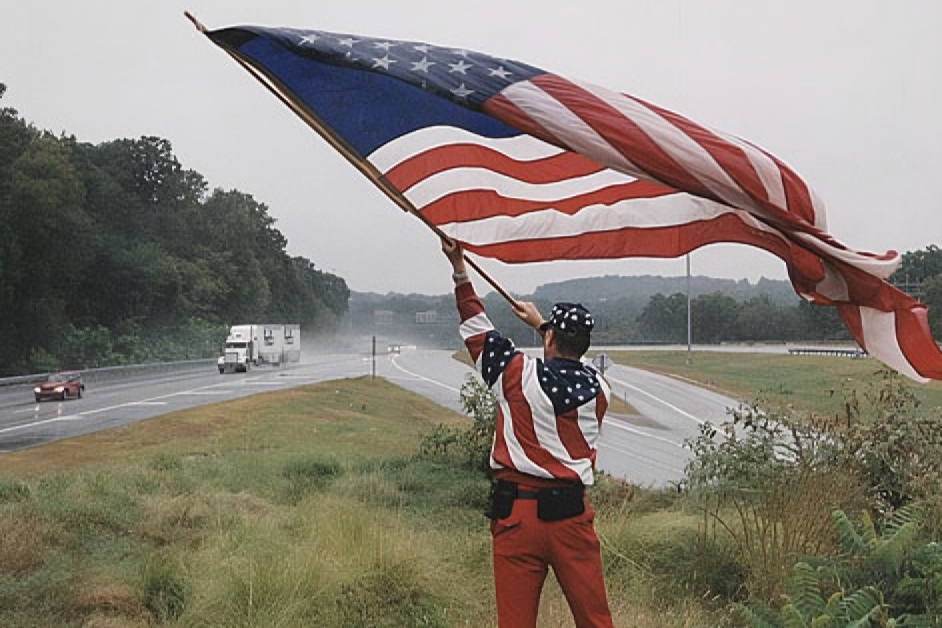
People gathered at highway exits and entrances. Waving American flags. Dozens of them. Hundreds.
I'd never seen anything like it. They weren't protesting. They weren't grieving alone. They were standing together, showing up, saying: We are still here. We are Americans.
It felt like they were cheering me on. Cheering all of us on. At gas stations, strangers talked to me like neighbors. Open. Raw. Heartbroken but kind.
I realized I was witnessing something profound. An American tragedy, yes. But also an American response. Ordinary people with ordinary lives, reaching out to each other.
It sparked something within me—a renewed sense of trust and connection.
The drive became more than a journey home. It became a path of discovery. Somewhere in Ohio, as the road stretched endlessly ahead, a thought surfaced.
I wished I had my camera.
I'm a shutterbug. Always have been. I love color, motion, and light. I've documented my life through photographs—my family, my friends, strangers, moments frozen in time.
But I didn't have my camera. And here I was, witnessing history. Unable to capture it. The regret stung. But then clarity followed.
What if I used my camera to tell uncommon stories?
To seek beauty in chaos? To inspire others to see wonder through my lens?
It felt like the first true thought I'd had in days. In that brief moment of lucidity I realized how meaningful it was when I peered at life through the eye of a camera.
Maybe this was my purpose. Not board meetings. Not dot-com ventures. But this—finding meaning through the camera lens and showing the world what inspires me.
I made a silent vow: If I get home safely, I will change my life. I will follow this dream.
We crossed into Pennsylvania, marking the halfway point of our journey.
The atmosphere shifted. Quieter. Heavier. We passed Pittsburgh, Somerset, Bedford, Harrisburg. I started talking to Chris and Lisa about New York. The Big Apple. The city that never sleeps. I described Times Square and Central Park.
I shared fond memories of savoring classic New York-style pizza, folded perfectly in half, enjoying hearty bagels topped with creamy lox, and indulging in rich, dense cheesecake. For a few moments, this reminiscing lifted my spirits as I described in detail all that I knew about this beautiful city.
But then my thoughts returned once more. New York City now stood at the heart of the world, and my mind drifted again to the tragedy of September 11.
Who could possibly commit such an act?
What kind of hatred runs so deep that someone would be willing to die for it—and take thousands of innocent lives with them?
None of my questions were answered.
Night had settled in as we approached Allentown, still a hundred miles from New York. My first stop was Newark Airport, to drop off Chris and Lisa. By then, I had already been behind the wheel for 12 hours. We were all exhausted and feeling nervous as NYC got closer and closer.
And then a storm crashed in. Lightning flashed and lit up the sky. Wind slammed the car. Rain hammered down, blinding me. Trucks roared past, tossing water everywhere. The road vanished under sheets of water. I gripped the wheel, scared I’d crash and die.
I eased my speed down to thirty miles per hour. My hands throbbed from clenching the steering wheel so tightly. Fearful that I might never see my family again, I pressed onward. It felt as though I was being tested—my courage, determination, and will all pushed to their limits.
Every instinct screamed: Pull over. Stop.
But a voice inside me, quiet and insistent, said: Keep going. It was the same voice I'd heard when I changed my flight. I listened.
Yes, I can.
We finally made it to Newark just after 1:00 a.m. I dropped off Chris and Lisa. We shared a weary but heartfelt hug. Though I'm not usually one to pray, I quietly wished for their safety before driving away. Deep down, I knew our paths would never cross again, yet I was certain I would always remember them.
My car was parked at JFK. Routes through Manhattan were blocked. I headed south, crossing the Goethals Bridge from New Jersey. The rain hadn't stopped. The wind was brutal. Trucks roared past, spraying water across my windshield. I missed a turn and ended up on the Brooklyn-Queens Expressway heading north. An hour out of my way. Flooded roads. Closed ramps.
After 18 grueling hours on the road, I navigated the storm alone, white knuckling the steering wheel tightly. Lightning flashed, illuminated the sky. In the distance I caught fleeting glimpses of the New York skyline shrouded in thick plumes of smoke, while Lower Manhattan lay blanketed in white ash.
The Twin Towers had vanished—replaced only by smoke, white ash, and a darkness where there once was light.
Is this real? Did I actually survive? Or am I dead, and this is Hell?
That unsettling thought took hold of me, and I couldn’t shake it.
At 4:30 a.m., still pouring rain, I returned the rental car at JFK. The Hertz agent offered me a ride to my car in short-term parking so I wouldn't get soaked.
A small kindness. I couldn’t have been more grateful.
I sat in my own car, finally. The rain was easing. The sky showing hints of dawn.
Quiet. Serene.
I am a lucky man.
I turned the key. Two more hours to Connecticut.
Will I make it home?
The question lingered, even though I knew it was irrational. Trauma does that. It twists your thoughts inside out. Yet as I drove, the familiar feel of my own car, the familiar road… gradually calmed me.
For the first time since September 11, my nervous system began to settle. I was going home. This was my journey back to reality as the shock of the last few days began to fade away from my sight.
An hour after sunrise, I pulled into my driveway. As I drove up to the house, it struck me that I had made it through—I truly was a survivor.
I walked inside. Joyce was still sleeping. I went to her bedside and held her, feeling a love so deep it ached. I crawled into bed, exhausted beyond words. As I drifted off, my thoughts lingered: A quiet voice. A changed flight. Synchronicity.
I had received an extraordinary gift—the invaluable gift of life. But for what purpose?
Awakening
I slept most of that day, waking in fragments. Still in shock, I kept thinking if I hadn’t listened to that small voice within, I would be dead. Listening to my intuition was something I knew would become more and more important to me from that day forward. The Universe had my full attention.
Something within me had shifted, moving me toward a different trajectory.
I was listening.
Before 9/11, I was consumed by corporate life. Eleven business ventures. Countless meetings. Chasing success I couldn't even define. During that long drive from Missouri to Connecticut, something cracked open.
I realized: None of this matters. Not the deals. Not the boards. Not the relentless pursuit of more. What mattered was meaning. Purpose. Listening to the quiet voice within.
I was given a second chance—not to continue along my old path, but to awaken to my true purpose in life.
In that moment, I caught only a faint glimpse of what my purpose might truly be. Although I didn’t fully understand it yet, one thing became clear: photography would guide me forward like a North Star. The passion I’d carried since childhood, long hidden beneath years of duty and obligation, was calling me back. I wanted to use my camera to capture beauty, to search for meaning, and to show others what truly matters.
It wasn't a small decision. I'd spent my entire life providing, achieving, and performing. I had three children, one disabled. A wife. Heavy responsibilities.
But for the first time, I understood: success without an internal compass is meaningless.
I suddenly felt a calling to discover my true self, to break free from the confines of the role I had been placed in, and pursue what my soul truly desired. My mission was clear: to follow the signs and guidance I received. Each step along this journey would lead me forward and encourage me to continue.
That drive across America was just the beginning.
Synchronicity
Synchronicity is often described as meaningful coincidence—events that align in a way that feels too perfect to be random. For those seeking a deeper understanding, synchronicities are often seen as confirmations of alignment and harmony with our purpose in life, acting as nudges from the Universe and directing us to the right path. These synchronicities often appear when we are at a crossroads, causing us to pause and pay attention to our current thoughts.
When you listen closely to your inner voice (your intuitive "knower"), you'll notice that these subtle signals and recurring patterns become more frequent. By practicing mindfulness and staying fully present, you enhance your ability to recognize synchronicity. This heightened awareness allows synchronicity to reveal itself more clearly in your life. This is when you realize the Universe is profoundly supporting you.
On September 10, 2001, I listened to a quiet voice and changed my flight. That voice saved my life and it set me on a path I'm still walking. And once I started paying attention and started asking why, I couldn't stop.
What was I meant to do with this second chance?
And where did that quiet voice come from?
The answers, I would discover, lay buried in the past. In a fortress city called Kovno. In the story of a Corsican nobleman and in the legacy of ancestors I'd never met, but whose courage ran through my veins. This is where my story of The Kovno Legacy truly begins.
If you choose to come with me on this journey, you may discover what's calling you, too.
What a beautiful discovery that would be.